


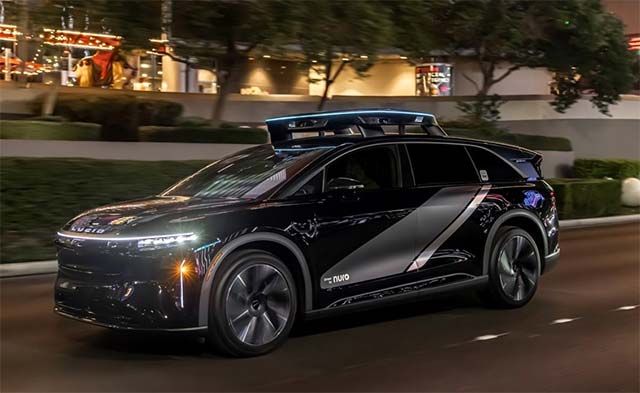
Lucid Group, Nuro and Uber Technologies unveiled the production intent vehicles that will be used in their global robotaxi service and introduced the Uber-designed in-cabin rider experience for the first time at the Consumer Electronics Show (CES) 2026.
The companies also announced that autonomous on-road testing began last month, an important milestone in the development and validation of the robotaxi service ahead of its expected launch in the San Francisco Bay Area later this year. Nuro is leading the testing using robotaxi engineering prototypes supervised by autonomous vehicle operators, beginning in the Bay Area.
At the show, visitors will have a first look at the robotaxi, as well as the in-cabin rider experience. Highlights of the robotaxi will include:
– A next-gen sensor array featuring high-resolution cameras, solid-state lidar sensors, and radars that provides 360-degree perception. These sensors are integrated throughout the Lucid Gravity’s body and in the purpose-built roof-mounted halo, which is a low-profile module designed to maximize visibility while preserving the vehicle’s signature design.
– Halo-mounted integrated LEDs help riders easily identify the correct vehicle, display rider initials, and provide clear status updates from pickup through dropoff.
– An intuitive in-ride experience that builds on the unprecedented comfort of the all-electric Lucid Gravity, with interactive screens that let riders personalize their autonomous journey — from heated-seat and climate controls to music, as well as options to contact support, or request the vehicle to pull-over.
– In-vehicle visualization that shows what the robotaxi sees and its planned path in real-time, including maneuvers such as yielding to pedestrians, slowing at traffic lights, changing lanes, and dropping off a passenger.
– A versatile, spacious layout with configurations that comfortably fit up to six passengers and offer generous luggage space, creating a premium solution for group travel.
– High-performance compute based on NVIDIA DRIVE AGX Thor, part of the NVIDIA DRIVE Hyperion platform, supporting the real-time AI processing and system integration required for advanced autonomous driving.
Autonomous on-road testing is part of Nuro’s safety and validation framework, honed over years of commercial autonomous deployments. The program evaluates dozens of critical capabilities across the full autonomy stack including Nuro’s end-to-end AI foundation model, which blends state-of-the-art AI with clear, verifiable safety logic for comfortable, reliable performance. In addition to on-road testing, the program includes closed-course testing and simulation to validate performance across a wide range of scenarios.
Pending final validation, the production intent robotaxi is expected to start production at Lucid’s Arizona factory later this year.